Friday, December 12, 2008

picture for week 8 

Week 1


So for week one, we went to freerice.com. By defining words you can help donate rice to starving people. So in addition to helping others, I also learned some new vocabulary. Others should do this because its informative, and your helping others. 


Week 2


Posting your six-word memoir. Mine read, “After 18 years, I’m finally home.” Which has to deal with my moving in with my dad and such. It felt good to get that idea out there. But it was really hard to do so in just 6 words. Others should do it because it is cleansing but also challenging. 


Week 3


I chose a storycorp story when Alex Cohen interviews her father who grew up in the 60s and when he was in his 60s he became addicted to methanphedimeans. I think everyone should listen to this story because it shows that at any age, you can become addicted at age. 


Week 4


I went to Web of Language and read a story about how the University of Illinois has banned the use of the male pronoun. Mostly because when gender is undefined, we as a country had a tendency to revert to the male. So, from now on everything must be non-gender specific. This site was interesting and informative when it come to the English language. 


Week 5


I was madly in love with the panda from the fist video and while weird, the first video was pretty informative. I loved the second video. It was super amusing and informative. Gave me a better understanding. Everyone shoudl go watch them jsut because they’re funny. 


Week 6


When I went and read it, It was especially touching because it was about how Colleges are promoting random acts of kindness. The one about the pillows from Penn State struck a special cord with me. For my act of kindness, I would hand out stuffed animals in the hospitals. Everyone should read because the stories are inspiring. 


Week 7

http://www.youtube.com/watch?v=Zp710JYJ6vs

http://www.youtube.com/watch?v=R-mmOL0qhm4

http://www.youtube.com/watch?v=RMXvudlK8VY


Week 8

My sources were all books, written pretty much before there was email. So, I couldn’t do this part of the extra credit. 


Week 9


I dressed up as an Eskimo for Halloween. For me, It related to the ideas in Indian Camp, how the Native American’s are beneath the white settlers. It also related very much to my paper, which had to deal with Surnames and Identity. 


Week 10


I voted in the presidential election which was empowering and made me feel like I had made a difference, especially because both the State I’m from, Pennsylvania and Florida were both swing states, so I really did feel like I was making a differenece. 


Week 11


I missed the deadline for submitting, but had I been able to submit I would have sent in my essay about Ireland. Which I’m very proud of. 


Week 14


http://www.1000000monkeys.com/snippet.html?branch=12173


I replied to someone else’s story =]

Wednesday, December 10, 2008

4 Modes

Visual 

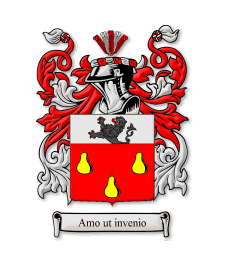
The visual I chose was a family crest. The choosing of this was pretty self-explanatory. My paper was about surnames, so the only visual that made sense to me was the family crest. It represents everything that is a surname, the meaning and the parts of it. Every symbol on the family crest represents something about the family, it’s origin and sometimes certain historical aspects of the family. 

Family crests are very important in many society. Especially when it comes to aristocratic and ancient families. The crests were displayed in a place of prominence and sometimes even on the shields of knights. They were a way of identification and people took pride in their family crests, just like today people often take prides in their last names. I know that I do. 


Book (Logos)

I have not actually read this book, because cost wise it was pretty expensive. However, I can guess what it is about just from the title of the book. It deals with Geography and Genealogy.  This was something that I remembered reading about when I was doing my project. So it was interesting to me to find a book that also talked about this in regards to the United States. 

When I was researching for my paper, I found in two or more of my sources that it has been found that surnames in England tend to congregate in one place. In my own experience I have also found this to be true. The only Brennan’s I have ever met have been Irish, and living in the greater Tri-state area. Many names I have never heard outside of Scranton, Pennsylvania. 


Movie (Pathos)

For the Movie I chose The Namesake. It is a movie about a family from India who immigrated to the United States. It follows the adventures of their one son, Gogol who is just struggling to fit in in the United States. His family is very traditional, but Gogol is not. The movie is about struggling to balance two cultures. 

I feel that many immigrants to the United States have to do that. This is why things like the Irish-American Club were founded. It’s also why places like China town popped up. It’s easier to adjust to a new place when you have people around you who speak the same language as you and practice many of the same customs. 


Song

The song I chose is called I’m Still Here (Jim’s Theme) and is is sung by John Rzeznik of the Goo Goo Dolls. The song is featured in the motion picture, Treasure Planet. The song speaks about identity and finding out who you are. The lyrics read, “They’d don’t know me. “ Jim struggles to find his way. 

He is fatherless and as such, really does not know who he is. He wants to understand his family and where he came from but it’s hard for him when his father walked out on his family. The song is played during a part in the movie where Jim finds his calling and feels truly at home with himself.  

Tuesday, November 18, 2008

Annotated Bibliography

Vogler, Christopher. "The Writers Journey, Stories are Alive " The Writer's Journey : Mythic Structure for Writers. By  Christopher Vogler. Vol. 3. Studio City, CA:  Michael Wiese Productions, 2007. 293-312.


Summary

Basically this section of Vogler just sums up everything else he has taught us throughout the book. He talks about the Shaman character and compares it to the writer. In addition, Vogler spends much time talking about Rumplestilskin. He introduces us to points about the story that I had never considered. As a child or as an adult. Vogler also tells us that he thinks stories have healing power. They allow us to explore another part of ourselves, temporarily forget the problems or issues we may be having. 

He also talks about the difference wants and needs and the power of wishing. Vogler spends a good deal of time talking about the wishes of the audience as well. There is a fine line you walk as a writer between the needs of your story and your own wants and that of the audience. It is important to appease the audience and also stay true to the integrity of the story.


Reflection 


I liked this section. Especially the part about Rumplestilskin. The story was one I remember hearing many, many time when I was little. In fact, I’m pretty sure I owned a movie about it at one point. For me, it was always clear cut that Rumplestiskin was the bad guy, but after reading this section of Vogler I’m not so sure about that. Tehre must have been a reason for him doing what he did. I almost want to hear his part of the story. 

The idea that stories have healing power is also something that struck home with me. I know first hand that a story can change your life. It might not be a written story, but one that someone tells you. It’s important to hear the perspectives and lessons that others have learned. Stories do just that. 


Questions


Do you agree that stories have healing power?

What do you think the other side of the Rumplestilskin story was?

Can you think of any stories that have changed your life?

Tuesday, November 11, 2008

Annotated Bibliography

Vogler, Christopher. "The Epilogue " The Writer's Journey : Mythic Structure for Writers. By Christopher Vogler. Vol. 3. Studio City, CA:  Michael Wiese Productions, 2007. 230-290.


Summary 


In this section, Vogler concentrates on showing the reader how the Hero’s Journey applies to certain popular films. Before doing so though, Vogler makes sure that the reader understand that the Hero’s Journey is a guideline and that in fact, audiences often prefer a story that is unique and different and actually strays from the stages in the Hero’s Journey. Vogler tells us that it isn’t a formula for a story. 

He goes on to talk about several popular movies; Titanic, The Lion King, Pulp Fiction and Star Wars. The most interesting are the Lion King and Titanic. From a production point of view Titanic was suppose to be a giant flop. It was the most expensive movie ever produced, and there was no way that it would return that profit. But it did. Vogler spends much of his time telling us why Titanic actually worked. The Lion King is an example of a movie that very closely follows the hero’s journey. It is probably the closest to the Journey I can think of. 


Reflection 

I really liked this part of the reading. By using examples Vogler not only helped me to understand but he gave me insights into movies that I love. For example, I had no idea that the Lion King was originally going to be very different. It’s a movie that I love very much, so thinking that something about it might be changed was strange. I think that some of Vogler’s ideas would about Rafiki would have helped the movie actually. 

I also loved talking about the Titanic. I remember seeing it in the movie theater when I was 8 years old and instantly falling in love with Jack. I liked the insight provided into his relationship with Rose. They are one of my favorite movie couples, and I loved the fact that Titanic was suppose to be a bust. Instead it is one of the highest grossing movies ever, and won a record breaking amount of oscars. 


Questions 


Why do you think Titanic was so successful?

Is there anything you would change about the Lion King?

Can you think of any examples were that doesn’t follow the hero’s Journey?

Thursday, November 6, 2008

4 nodes

Book - Geography and Genealogy  by Dallen J. Timothy and Jeanne Kay Guelke

Movie - The Namesake 

Song - I'm Still Here (Jim's Theme) - Sung by Johnny Rzeznik (Goo Goo Dolls) 

Visual -  family crest 


Annotated Bibliography

Get out of jail free!

Monday, October 20, 2008

Annotated Bibliography

Vogler, Christopher. "Approach to the Inmost Cave and The Ordeal " The Writer's  Journey : Mythic Structure for Writers. By Christopher Vogler. Vol. 3. Studio City, CA:  Michael Wiese Productions, 2007. 143-173.


Summary 

Just like everything else, the type of hero you have in a story determines the way they will approach the inmost cave. Some heros approach it willingly, while others do not. If you are unsure about the type of hero in a story, the way they approach the inmost cave can also help you to determine that. For example, a confident committed hero will approach the cave willingly. Other heros are much more timid and they take much more time to prepare and think about what is going on. This approach to the cave is also a good time to regroup and recalibrate the group of character around your hero. No matter how hard a hero tries, eventually he will have to face the ordeal. 

The simple secret of the Ordeal is that heros must die so that they can be reborn. This run in with death serves several functions. It allows for change and character growth within the hero, no one comes back from the brink of death unchanged. The Ordeal is often one of the deepest depressions in a story and so it leads to the highest highs for both the audience and the hero. It involved growth, and emotion. 


Reflection 

Once again, I liked reading this section because I felt like it actually taught us something new instead of constantly reinstating what previous chapters had already said. I particularly enjoyed the section about the Ordeal. I liked how he used Star Wars as an example. It was easy to identify with, and it helped to illustrate the point that Vogler was getting at. I recently watched The Prince of Egypt, and when he talked about a character being reborn to heighten the emotion of the audience, I could immediately pin point that section of The Prince of Egypt. 

When I thought back about it, the simple secret that Vogler explains makes so much sense to me. Any time I see a hero “die” I am so much more elated when I find out he’s alive. Vogler is very good at pointing things out that I never actually realized before. 


3 Questions 


What are some examples of approaches to the inmost cave that you have seen in your own life?

Do you find that many of the movies you watch or stories you read involve the death and rebirth of a hero?

Why do you think this death and rebirth is so important?